The Magical-Looking Water of Tsalal Island

How Edgar Allan Poe accidentally predicted the discovery of liquid crystals.
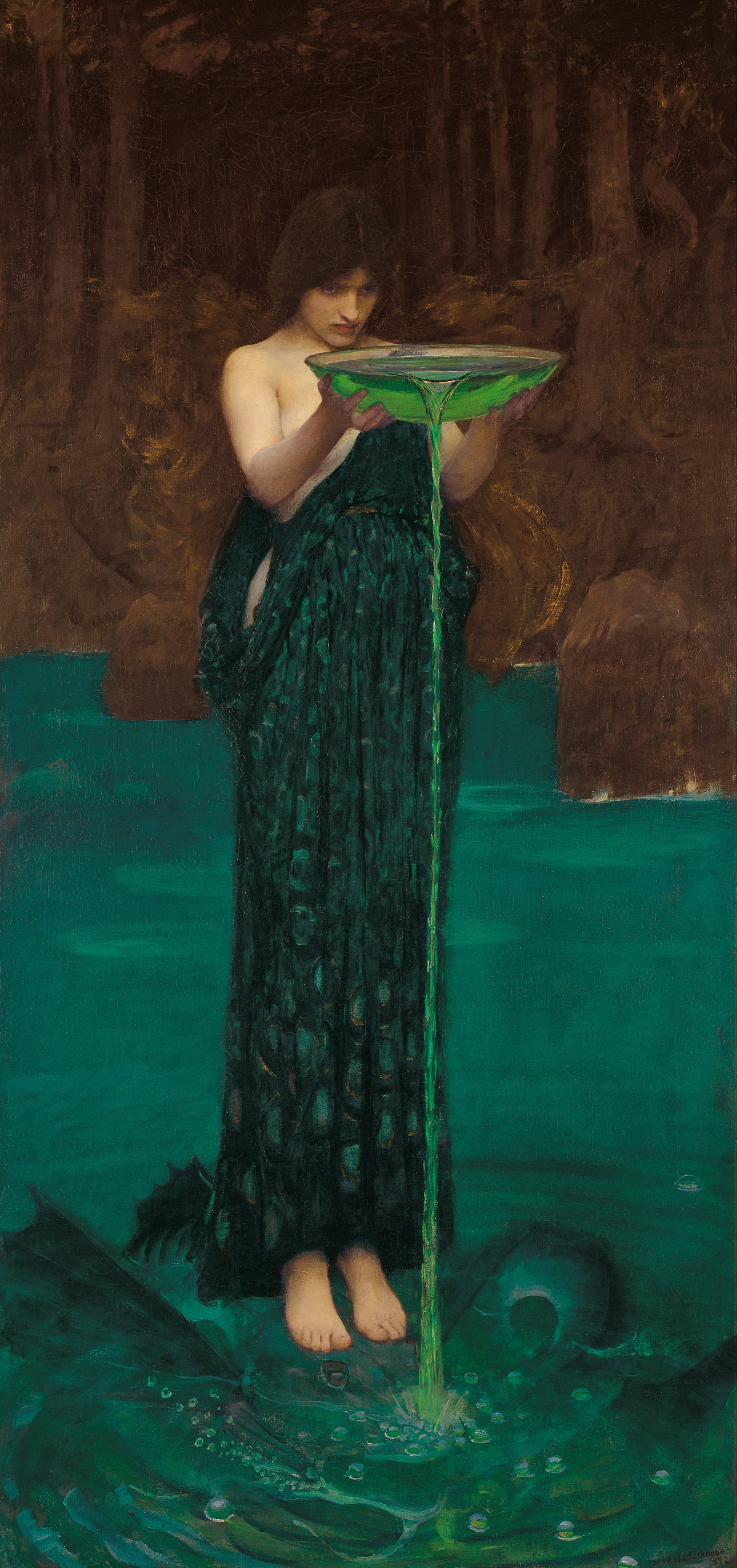
Another reason was, that the incidents to be narrated were of a nature so positively marvellous, that, unsupported as my assertions must necessarily be, I could only hope for belief among my family, and those of my friends who have had reason, through life, to put faith in my veracity—the probability being that the public at large would regard what I should put forth as merely an impudent and ingenious fiction.
— A.G. Pym (Poe 1838)
The account given below of the unusual water in the streams of Tsalal Island, from Edgar Allan Poe’s The Narrative of Arthur Gordon Pym of Nantucket (1838), is claimed by Encyclopedia Britannica (Mahan and Widom 2024) to be “perhaps the first description of a liquid crystal,” a complex physical state of matter that sets life apart from the nonliving, facilitates the operation of the animal brain and sensory systems, allows the existence of consciousness and provides an explanation for a significant portion of what we don’t currently understand in areas such as aesthetics.
Arthur Gordon Pym, the main character in Poe’s novel, initially a stowaway on a whaling ship, finds himself aboard the schooner Jane Guy on an expedition in the Southern Ocean after various unexpected events at sea. Although it starts out as a realistic adventure story, and claims to be a record of true events, things become increasingly supernatural as Pym travels south. At about the eighty-fourth parallel, with “the sea being of an extraordinarily dark colour,” the crew comes across an archipelago. They anchor the ship and travel inland accompanied by native inhabitants on an island called Tsalal, the name of which is pronounced with a prolonged hissing sound. Along the way they discover the trees are nothing like other trees, the rocks are “novel” in their mass and color, and the people are “the most wicked, hypocritical, vindictive, bloodthirsty, and altogether fiendish race of men upon the face of the globe,” but the strangest thing about Tsalal is the “singular,” “magical-looking,” liquid crystal-like water flowing through its streams:
I am at a loss to give a distinct idea of the nature of this liquid, and cannot do so without many words. Although it flowed with rapidity in all declivities where common water would do so, yet never, except when falling in a cascade, had it the customary appearance of limpidity. It was, nevertheless, in point of fact, as perfectly limpid as any limestone water in existence, the difference being only in appearance. At first sight, and especially in cases where little declivity was found, it bore resemblance, as regards consistency, to a thick infusion of gum Arabic in common water. But this was only the least remarkable of its extraordinary qualities. It was not colourless, nor was it of any one uniform colour — presenting to the eye as it flowed every possible shade of purple, like the hues of a changeable silk. … Upon collecting a basinful, and allowing it to settle thoroughly, we perceived that the whole mass of liquid was made up of a number of distinct veins, each of a distinct hue; that these veins did not commingle; and that their cohesion was perfect in the regard to their own particle among themselves, and imperfect in regard to the neighboring veins. Upon passing the blade of a knife athwart the veins, the water closed over it immediately, as with us, and also, in withdrawing it, all traces of the passage of the knife were instantly obliterated. If, however, the blade was passed down accurately between the two veins, a perfect separation was effected, which the power of cohesion did not immediately rectify. The phenomena of this water formed the first definite link in that vast chain of apparent miracles with which I was destined to be at length encircled.
According to King (1969), liquid crystals, specifically of the “cholesteric” or “chiral nematic” variety, were first described by the Austrian botanist Friedrich Reinitzer in 1888, and named by Otto Lehmann in 1889, half a century after Poe’s book was published (1838), so it’s impossible for Poe to have given a firsthand description. There is, however, a way for him to have done so inadvertently. Plasma membranes, a major component of all cells, including most relevantly neurons, are liquid crystalline in their physical composition, making the structure of the brain isomorphic with the water of Tsalal, and providing a connection potentially allowing Poe to have come up with such an accurate depiction of an undiscovered state of matter.
Tsalal water is, in many ways, more complex, lifelike and brain-like than normal water. Its complexity is evident in terms of description length, as Poe points out. It’s separated over short intervals into more and less viscous sections, with an overall consistency in between that of a normal fluid and solid. It’s both “perfect” and “imperfect” (order~disorder) at the same time, both clear and many changing versions of the color purple. It somehow flows rapidly while also being thick like gum arabic, or acacia tree sap (dynamic~static), and has the life-like property of recovering its structure, somewhat, after being disturbed in particular ways. Any of these qualities could contribute to the reason Poe’s magical water is so often given as the original liquid crystal description (Dunmur and Sluckin 2014): “These days, liquid crystal scientists like to speculate that Poe, through some remarkable insight, had imagined the liquid crystals of the future.”
Britannica probably got the idea from Kelker’s “History of Liquid Crystals” (1973) or an article titled “Cholesterics Already Described in 1838!” by Stegemeyer and Kelker in the journal Liquid Crystals Today (1991), in which the authors ask: “Can anybody answer the question where Edgar Allan Poe received information about cholesterics? Or was he a clairvoyant?” One answer typically given is that Poe must have observed semi-solidified blood outside the body in American slaughterhouses (Petrov 1999), which would have been similar to the water of Tsalal because “In its usual state within the human body, blood is an ordinary disordered isotropic fluid. The disklike shape of red blood cells, however, favours liquid crystallinity at certain concentrations and temperatures” (Mahan and Widom 2024).
Arguably, however, the complexity of the water goes beyond what might be expected in a portrayal of partially coagulated blood in buckets at a slaughterhouse, and if he had that experience it hardly follows he would choose to apply it to the water on an imaginary island in a future story. Poe saw any number of things with liquid crystal-like properties, such as a thick infusion of gum Arabic in water, which he mentions, or various other physically intermediate substances, but this alone wouldn’t be sufficient to explain his motivation.
Happening to encounter something doesn’t, by itself, lead a person to reproduce the thing artistically. There’s an important distinction to be made between having an experience and being inspired by it. A musician doesn’t remake a song just because they’ve heard it somewhere before. It’s also because they like the way it sounds. A person doesn’t repeat a joke only because someone told it to them, but also because they thought it was funny.
Amusing things spread by capturing and holding our attention, persisting in the mind and tempting us to repeat or recreate them to a greater degree than unamusing things. It’s not the singer that makes a song musical, the poet that makes words poetic or the comedian that makes a joke funny, it’s something about the mind and brain of the observer. Artists don’t invent beauty and unconsensually impose it on their audience. Rather, they exploit biases that were already in place. Poe thought readers would like the water because he liked it himself, whether he got the idea from something he saw, heard in a conversation, read in a book, dreamt in a dream, or if he came up with it out of nowhere. Even if he could have learned about liquid crystals by looking into the future the question of why he was intrigued by the concept would still need to be answered.
Assuming a phenomenon gets remembered, is reproduced or passed on simply because it occurred at some point in the past is a logical mistake known as an origin fallacy, in which factors other than initial existence are ignored even though they might play a key role in the outcome under consideration. This is a prominent issue in aesthetics generally, perhaps especially so in language. It’s easy to think that we use the expression “break the ice” because Shakespeare used it in The Taming of the Shrew, disregarding that we also probably say this because we like the idea of destruction mixed with solidness and associate lack of interaction with coldness. It’s easy to think we say there’s “method to the madness” because Shakespeare said something close to this in Hamlet, when in reality we repeat the phrase because we’re interested in juxtapositions of order and chaos.
Though this be madness, yet there is a method in't.
— Shakespeare, Hamlet (2022)
Regardless of where Poe got the idea of a semi-solid, semi-rapid, semi-orderly stream, the real mystery is why he found it amusing, and thought, correctly, that others would as well. The simplest way to understand Poe’s apparent clairvoyance is a universal aesthetic bias in favor of fluidity coupled with solidness, which arises as a side effect of the special, simultaneously fluid and solid condition of the brain itself. The introduction of Esther Leslie’s book Liquid Crystals: The Science and Art of a Fluid Form, titled “Slush,” describes a famous painting from the early 1800’s by Caspar David Friedrich:
There is an old image of liquid crystal. It is an image of liquid turned crystal and crystal amid liquid. It is a painting known in German as Das Eismeer, which literally means the ice sea or the Sea of Ice, and refers to a polar sea, such as is found in the outermost North or most extreme South of the globe.
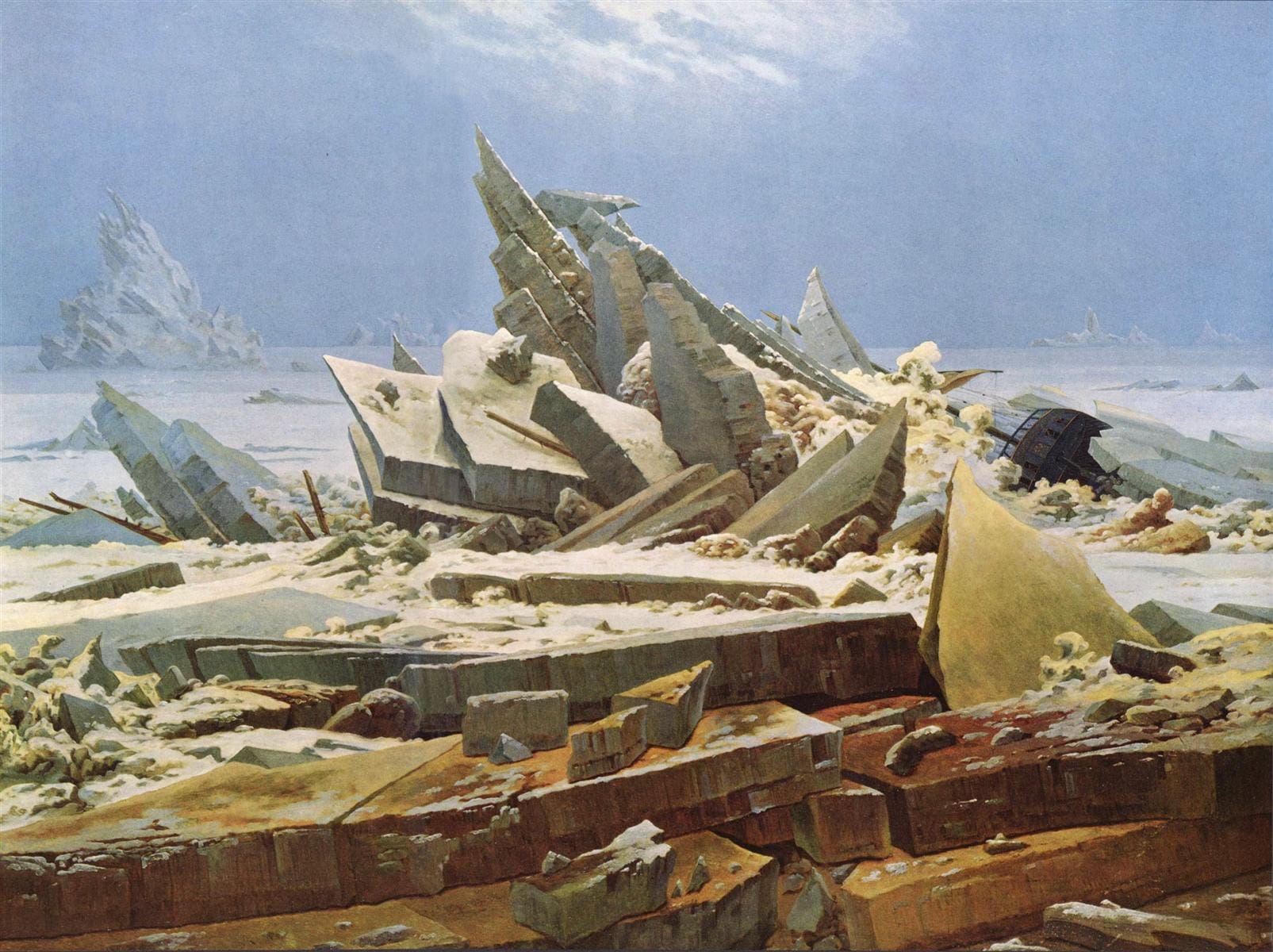
Leslie’s prose is poetic, with six mentions of fluidity interspersed with five mentions of solidness in the first two sentences, although in the painting itself there doesn’t seem to be any unfrozen water. She continues in the second paragraph outlining juxtapositions one might appreciate in the painting, some of which are indicated in brackets:
The Sea of Ice [fluid~solid] depicts expanses of ice amid seawater [fluid~solid] under a frozen sky [up/fluid~cold/solid]. Above the horizon there is only the tiniest hint of possible warmth [hot~small], radiating from off the painting’s edge. The crystals of ice that ostensibly form the main subject of the painting appear in many forms and shades [many~solid], mutable as the water that makes them [dynamic~solid]. In the foreground are plates and chunks of ice mixed perhaps with soil, the brownish edge of land, which lies somewhere unseen and unspecified. These rusty ice blocks [red~cold/solid] resemble rubble [disorder~solid/cold] and bricks, or slabs of stone churned up [disorder/up~solid/cold] in a graveyard where death occurred long ago. In the middle ground, a greyish spike of ice skewers the freezing waters [fluid~solid, spiky~solid]. Behind it, to the left, another bluish-white [dark~bright] iceberg juts from the ocean and begins to merge with the sky [fluid~solid] and the horizon. Further back, other spears of ice [spiky~solid/cold] have melded with the chilly blue of the sky [cold/blue~up/fluid]. Some of the ice and snow is opaque, some is translucent. The dirty brown ice pile in the foreground is transmuted, in the distance, into a luminous crystal palace [bright~solid], hinting at the possibility of something better on the horizon, something beautifully crystalline, not destructively splintered. There are clumps of softer greenish and yellowish snow [yellow~green] and, here and there [in~out], frosty dustings of new snow. The icebergs have edges that are like jagged fragments of glass [disorder/spiky~cold/solid].
Leslie is apparently the first person to connect art and beauty to state of matter physics in the brain, the main idea being that the isomorphism between liquid crystallinity in neurons and the contrast between fluid and solid in aesthetic phenomena is not coincidental; the former causes the latter, and this also goes for order juxtaposed aesthetically with chaos and motion with stillness.
Assuming she’s right, isomorphism between Tsalal water and the brain also isn’t a coincidence, and Poe didn’t need to make any observations of liquid crystal-like phenomena, any more than Friedrich would need to experience a real world example of sea ice prior to composing the painting. Leslie makes the point that Friedrich had never travelled to the poles, where the scene depicted must have been situated. Likewise, a poet doesn’t necessarily rely for their creativity on being directly exposed to the concept of a poem, a writer to that of a story or a comedian to a joke.
The hypothesis is a three-part system of cause and effect: from brain liquid crystallinity (softness) to a bias in the mind for fluid~solid mixtures to the outwardly observable result: a fluid~solid aesthetic effect. Because of the universality of brain softness, the bias would be universal to humans, and to all animals with brains and sensory abilities sufficient to distinguish a fluid from a solid and recognize a mixture of the two. A fourth, ultimate cause could be added to the system: natural selection that initially favored brain softness because it allowed the evolution of consciousness and sensory systems that increased survival rates for individuals expressing them.
Fluidity, by comparison to its direct opposite solidness, corresponds everywhere in nature to dynamism and disorder in that all three qualities increase together with temperature. Oppositely, on small scales, solidness corresponds to stasis and order, all three qualities increasing together in matter as its temperature goes down. Liquid crystals, membranes, living matter, neurons and brains, like Tsalal water, are complex mixtures of disorder with order and dynamism with stasis in addition to fluidity with solidness. As such, it might be expected that the same three-part scheme of physical cause and aesthetic effect applies to the dualities dynamic~static and disorder~order. These would also be universal, by the same logic as fluid~solid, and the same isomorphism between thermophysical (temperature and state of matter related) conditions in the brain and aesthetic phenomena would apply, disorder~order and dynamic~static biases creating the connections, as predicted by Leslie. These cause and effect systems in general and others like them, along with the isomorphisms they give rise to, could be referred to as thermoaesthetic.
A bias for mixtures of disorder and order can explain why Tsalal water is both perfect and imperfect, and why this mixture is present elsewhere in the story. It’s in the juxtaposition of reality, such as references to actual expeditions, with fantastic events such as the magical water, fictional animals and the temperature increasing with more negative latitude (hot~cold). In a research article published in English Journal, Helen Lee (1966) says Pym “has an inexplicable urge to seek chaos and try to convert it to order,” and that a “rhythmic counterpoint between chaos and order creates the structure of the story.”
Since fluidity, dynamism and disorder are correlated in one physical and thermal direction, that of higher excitement, while solidness, stasis and order are correlated in the opposite direction, of lower excitement, the indirect mixtures fluid~static, fluid~order, dynamic~solid, dynamic~order, disorder~solid and disorder~static can also be predicted to represent universal biases and isomorphic aesthetic effects.
Tsalal Island water is not, by far, the only time something with a mixture of liquid and crystalline characteristics has appeared in creative literature. An example of the specific mixture water~crystal can be found the first lines of Poe’s poem “To the River—.”
To the River ——
Fair river! in thy bright, clear flow
Of crystal, wandering water,
Thou art an emblem of the glow
Of beauty — the unhidden heart
The playful maziness of art
In old Alberto’s daughter;
Other examples occur throughout literature going back thousands of years, for instance in Claudian’s “On a Crystal Enclosing a Drop of Water,” from the 4th century (2025). Claudian admires the beauty of a piece of ice containing some unfrozen water. The object is more precious because it’s not fully crystalline:
This piece of ice still shows traces of its original nature: part of it has become stone, part resisted the cold. It is a freak of winter's, more precious by reason of its incomplete crystallization, for that the jewel contains within itself living water.
Its “marvelous” for being both hard and wet at the same time:
Ye waters, who confine waters in a prison akin to them, ye that are liquid still and ye that were so, what wit has united you? By what trick of freezing is the marvellous stone at once hard and wet? what containèd heat has protected those enclosed waters? what warm wind melted that heart of ice? How comes it that the jewel in whose heart the water ebbs and flows was either made solid or liquid by frost?
Its crystallinity interacts with its fluidity to enhance its value:
Alpine ice was becoming so hard that the sun could not melt it, and this excess of cold was like to make it precious as diamond. But it could not imitate that stone in its entirety for at its heart lay a drop of water which betrayed its nature. As crystal its value is enhanced, for this liquid rock is accounted a miracle and the water enclosed within it increases its rarity.
Claudian emphasized that the water isn’t just fluid. It’s also dynamic, running this way and that:
See this vein which runs in a bright streak through the translucent ice. This hidden water fears not any blast of Boreas nor winter's chill but runs this way and that. It is not frozen by December's cold, nor dried up by July's sun, nor wasted away by all-consuming time.
He says the water is also errant, or disorderly, and alive. The object as a whole is more wonderful and strange than any pure liquid or crystal:
Safely hidden away in this round covering is a stream, an errant spring, enclosed within frozen waters. Mark you not how the crystal is all awash in its cavernous heart where living waters surge this way and that, and how, when the sun penetrates its frozen depths, the hues of the rainbow are reflected in it? Wonderful stone, wonderful water: stranger than all rivers and all stones because it is a stone and yet fluid.
The object is loved by children:
Children love to handle this shining crystal and turn its chilly mass over and over in their little hands; they see imprisoned in the transparent rock the water which alone winter forebore to freeze. Placing the dry sphere against their thirsty lips they press useless kisses on that which guards the waters they desire.
Its aesthetic value of surpasses that of all the jewels of kings, and Red Sea pearls, despite its “shapeless,” “rough,” “uncarven” form:
Do not despise this sphere of rock-crystal. Kings' palaces contain no rarer jewel, nor are the Red Sea's pearls of greater value. It may be shapeless ice, unpolished rock, a rough, uncarven mass, yet is it accounted among the most precious of riches.
This idea of a tolerance for disorder happens to be part of the argument Poe, who wrote himself into his own story as editor of the Southern Literary Messenger, used to convince Pym to publish his narrative in spite of how difficult it is to believe:
He [Poe] strongly advised me, among others, to prepare at once a full account of what I had seen and undergone, and trust to the shrewdness and common sense of the public—insisting, with great plausibility, that however roughly, as regards mere authorship, my book should be got up, its very uncouthness, if there were any, would give it all the better chance of being received as truth.
Fluidity mixed with solidness, where it can be expressed, is one of the most obvious and ancient aesthetic themes, recurring at high frequency not only in poetry and art but also idiomatic and metaphorical language, architecture, decoration, names and in the myths and rituals of seemingly every culture. It occurs far more often than would be expected unless the concept of a fluid reflexively tends to produce in the creative mind that of a solid and vice versa. This is also true for mixtures of motion with stillness and disorder with order. See “Aesthetic Mixtures of Fluidity and Solidness” and “Appendix 1: Lists of Monoaesthetic Mixtures” in the main story for hundreds of additional examples.
Other aesthetic patterns are similar in that they involve mixtures of opposites, both direct and indirect, although, unlike physical qualities, most of them can’t strictly be considered isomorphic with conditions in the brain. This includes everything from extremely fundamental, primitive perceptual dualities (e.g., hot~cold, bright~dark, red~blue, up~down, out~in, long~round, many~few) to the most recently derived cultural dualities (e.g., divine~mortal), suggesting that animal preferences in general are related to brain liquid crystallinity.
Notes
We are below the river‘s bed. The drops of moisture trickle among the bones.
— Edgar Allan Poe, The Cask of Amontillado
Ah, by no wind are stirred those trees [fluid~solid]
That palpitate like the chill seas
Around the misty Hebrides!
Ah, by no wind those clouds are driven
That rustle through the unquiet Heaven
Uneasily, from morn till even,
Over the violets there that lie
In myriad types of the human eye—
Over the lilies there that wave
And weep above a nameless grave!
They wave:—from out their fragrant tops
External dews come down in drops.
They weep:—from off their delicate stems
Perennial tears descend in gems. [fluid~solid]
— Edgar Allan Poe, “The Valley of Unrest”