Aesthetic Indifference
Neither the sun nor death can be looked at with a steady eye.
— François Duc de La Rochefoucauld, 1613-1680 (Bartlett 2022)
Nay, I'll come: if I lose a scruple of this sport,
let me be boiled to death with melancholy.
— Shakespeare, Twelfth Night (2022)
Strangely, any mixture of perceptual qualities (list 3) from opposite psychological excitement categories (lists 1 and 2) results in a duality with a structure descriptive of aesthetic phenomena, not only those involving direct opposites.
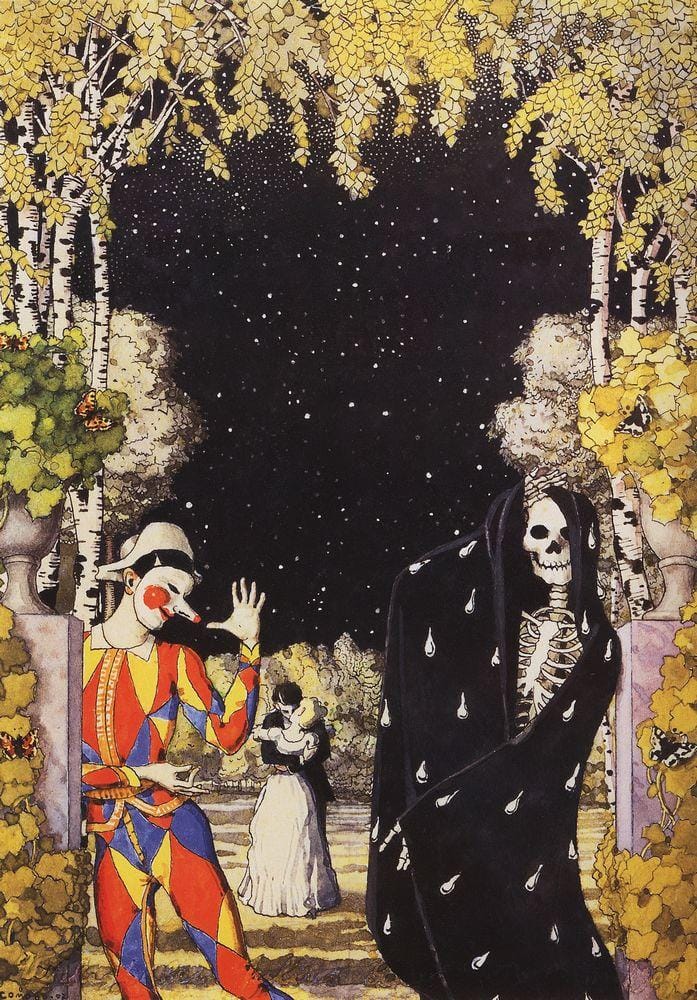
This works for Somov's painting, contrasting death with the humor of a harlequin, rather than the direct opposites life and death or humor and seriousness. It also works for the quote from Rochefoucauld, opposing death to the sun instead of life and the sun to death instead of darkness. The quote is amusing because it’s true, in a way, and because of the extreme contrast and differential excitement between the phenomena it refers to. There’s also the suggestion of dynamic stasis, a direct mixture, and of dynamic roundness, another indirect mixture, in an unsteady eye.
One can randomly choose any quality on the more exciting side, from list 1 for instance, juxtapose it with anything on the less exciting side, such as a quality from list 2, observe aesthetic material in which the mixture might be conveyed and find that it occurs at an unexpectedly high rate. Mixing the seven qualities hot, fluid, disorder, bright, dynamic, upward and outward in all possible ways with their opposites results in the set of 49 mixtures given below. Seven of these are direct opposites, and therefore possible to learn from the outside world, while 42, the majority, are indirect, or unlearnable, and yet they happen to be almost as important aesthetically as direct opposites, as anyone who looks for them will find. This also applies to the opposites given in Other Mixtures, and for mixtures made up of conceptual relatives.
For simplicity, the “warmer” colors red, orange and yellow can be thought of as types of brightness, and the “cooler” colors purple, blue and green as types of darkness, so that, for instance, anything black and white, red and blue or yellow and green exemplifies the mixture bright~dark (the contrast effect). Also, roundness can be thought of as a type of order, and spikiness and length as types of disorder, justified based on the symmetry versus relative asymmetry of the former compared to the latter. Directly opposite qualities are marked with asterisks.
Direct and indirect aesthetic mixtures (list 4): hot~cold*, hot~solid, hot~order, hot~dark, hot~static, hot~down, hot~in, fluid~cold, fluid~solid*, fluid~order, fluid~dark, fluid~static, fluid~down, fluid~in, dynamic~cold, dynamic~solid, dynamic~static*, dynamic~order, dynamic~dark, dynamic~down, dynamic~in, disorder~cold, disorder~solid, disorder~order*, disorder~dark, disorder~static, disorder~down, disorder~in, bright~cold, bright~solid, bright~order, bright~dark*, bright~static, bright~down, bright~in, up~cold, up~solid, up~order, up~dark, up~static, up~down*, up~in, out~cold, out~solid, out~order, out~dark, out~static, out~down, out~in.*
List 4 doesn’t include mixtures of sound (pitch and volume), left and right, size (big and small), multiplicity (many or few) or novelty. Including these qualities, and treating color as a separate variable from brightness and round~long/spiky as a separate dimension from order~disorder generates a long list of mixtures (324, see Appendix 1), more than it’s convenient to consider at one time, although all of them probably correspond to biases and therefore predict the structure of aesthetic phenomena. Examples of mixtures of sound, size and multiplicity are given throughout the text and in Monoaesthetic Mixtures, and roundness is discussed in its own section.
Due to aesthetic indifference, the term “mixture” as it’s used here means a juxtaposition between any of the qualities or concepts on the left side of the listed dualities with any of those on the right side. Heat is an opposite of coldness, as usual, but also of solidness, stasis, order and so on. Upward is the opposite of downward, but also the other less exciting qualities in dimensions of direction: inward, backward, central, the right side, and of every less exciting quality in list 2.