Fluidity and Solidness in the Philosophy of Biology

Philosophers have always recognized life as a complex mixture of fluid and solid components.
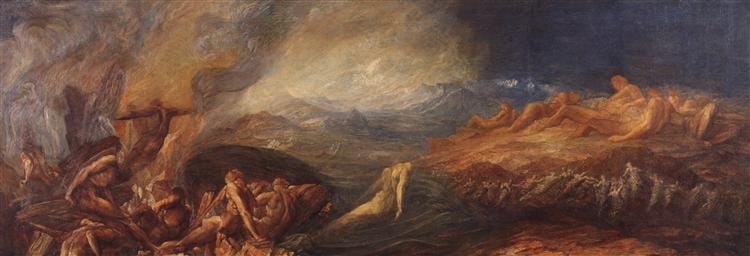
© 2025 Andrew Hodgson
That which is bound may be dissolved, but only an evil being would dissolve that which is harmonious and happy. And although you are not immortal you shall not die, for I will hold you together. Hear me, then: —Three tribes of mortal beings have still to be created, but if created by me they would be like gods. Do ye therefore make them; I will implant in them the seed of immortality, and you shall weave together the mortal and immortal, and provide food for them, and receive them again in death.' Thus he spake, and poured the remains of the elements into the cup in which he had mingled the soul of the universe.
— Plato, Timaeus (2012)
The idea of life as a kind of compromise between solidness and fluidity is not new. It goes back to the earliest creation stories, appearing repeatedly as a dualistic motif in which solids are infused with fluids to make humans or life. It’s expressed explicitly in the earliest philosophical thought, and repeatedly throughout the centuries in every part of the world, foreshadowing the discovery in 1888 that matter is in fact capable of existing for long periods of time as a physical, fluid~solid mixture, of maintaining itself in the process of a phase transition between a liquid and a crystal, and that it does so primarily in living systems.
Lao Tzu, always fond of a contradiction, made the argument at least 2,300 years ago in the Tao Te Ching (1996) that humans and plants transition from a dominant state of weak softness to one of strong solidness that’s easily subdued and adjacent to death:
A man is born gentle and weak. At his death he is hard and stiff. Green plants are tender and filled with sap. At their death they are withered and dry. Therefore the stiff and unbending is the disciple of death. The gentle and yielding is the disciple of life. Thus an army without flexibility never wins a battle. A tree that is unbending is easily broken. The hard and strong will fall. The soft and weak will overcome.
Disregarding the amusingly contradictory concept of weakness overpowering strength, an extremely popular aesthetic theme forming the basis of countless stories and found throughout the history of philosophy, this is an early recognition that organisms are made of soft (liquid crystalline) matter, and that we gradually solidify throughout our lives. Fluidity is being lost, so it must be present initially, and it wouldn’t be possible for beings already in a crystalline condition to crystallize. Anaximander (2012) said the same thing around 600 BCE:
Anaximandros said that the first animals were generated in the moisture, and were covered with a prickly skin; and as they grew older, they became drier, and after the skin broke off from them, they lived for a little while.
In Anaximander’s view, animals had been created as the vapors of earth were “raised by the sun.” Humans came later, developing from fish, “growing up as sharks do till they were able to help themselves, they then came forth on the dry ground.”
Other early Greek philosophers were at odds over life and its origins, with Thales claiming that like everything else it came from water, Anaximenes that it’s a type of condensed air, and Heraclitus (at least implicitly) saying it came from something fire-like, on account of life’s hot and dynamic nature and his observation of the fieryness of the soul. The volcano-diving philosopher Empedocles was convinced, justifiably so, of the more nuanced scenario of life coming about periodically as the classical elements earth, air, water and fire cycled between states of extreme unification and separation, imposed respectively by the predominance of Love and Strife. Life would arise between extremes when the elements were semi-distinct and mixed in the right proportions.
In the Timaeus (2015), Plato’s dialog between Socrates and the Pythagorean character Timaeus, “the framers of us” are said to have made the body out of various transformations and mixtures of fluid, solid, and soft matter. Bones were made from earth and wetness:
The bone was formed by sifting pure smooth earth and wetting it with marrow. It was then thrust alternately into fire and water, and thus rendered insoluble by either.
Marrow binds the relatively solid body to the relatively fluid soul. It’s made of triangles like the kind that assemble into different polyhedra to make earth, air, fire and water. For the marrows, though, including brains, spinal cords, nerves and seed, the maker used special, smoother triangles and “mingled them in due proportion.” He made “warm, moist” flesh out of earth, fire, water, acid and salt, using it to provide flexibility, cover the bones and keep them from breaking when we fall, and to protect us from heat and cold. A semi-liquid substance flows out of our heads through holes pierced in the scalp by fire and solidifies into hair:
Still, the head could not be left a bare globe of bone on account of the extremes of heat and cold, nor be allowed to become dull and senseless by an overgrowth of flesh. Wherefore it was covered by a peel or skin which met and grew by the help of cerebral humour. The diversity of the sutures was caused by the struggle of the food against the courses of the soul. The skin of the head was pierced by fire, and out of the punctures came forth a moisture, part liquid, and part of a skinny nature, which was hardened by the pressure of the external cold and became hair.
The fact that hardness and softness vary throughout a body was also addressed by Aristotle. As he put it in On the Parts of Animals (1882): “Of the homogeneous parts of animals, some are soft and fluid, others hard and solid; and of the former some are fluid permanently, others only so long as they are in the living body.” He thought animal bodies must have diverse properties in this regard to give rise to their diverse functions:
Animals, then, are composed of homogeneous parts, and are also composed of heterogeneous parts. The former, however, exist for the sake of the latter. For the active functions and operations of the body are carried on by these; that is, by the heterogeneous parts, such as the eye, the nostril, the whole face, the fingers, the hand, and the whole arm. But inasmuch as there is a great variety in the functions and motions not only of aggregate animals but also of the individual organs, it is necessary that the substances out of which these are composed shall present a diversity of properties. For some purposes softness is advantageous, for others hardness; some parts must be capable of extension, others of flexion. Such properties, then, are distributed separately to the different homogeneous parts, one being soft another hard, one fluid another solid, one viscous another brittle; whereas each of the heterogeneous parts presents a combination of multifarious properties.
The most vital body parts were thus understood in Aristotles’ time to be a mixture of fluidity and solidness. He used Empedocles’ physical system and assigned some of the classical elements and forces (fluidity, solidness and temperature) special significance in contributing to the structure of life:
Now there are three degrees of composition; and of these the first in order, as all will allow, is composition out of what some call the elements, such as earth, air, water, fire. Perhaps, however, it would be more accurate to say composition out of the elementary forces; nor indeed out of all of these, but out of a limited number of them, as defined in previous treatises. For fluid and solid, hot and cold, form the material of all composite bodies; and all other differences are secondary to these, such differences, that is, as heaviness or lightness, density or rarity, roughness or smoothness, and any other such properties of matter as there may be.
A body’s status in terms of hot versus cold and solid versus fluid is considered a major determinant of its structure. The balance of these is said to be responsible, in part, for sleep, health and aging, as well as long hair:
No animal has so much hair on the head as man. This, in the first place, is the necessary result of the fluid character of his brain, and of the presence of so many sutures in his skull. For wherever there is the most fluid and the most heat, there also must necessarily occur the greatest outgrowth.
Aristotle seems to have been convinced that heat, fluidity, length and outwardness are all related, implying an opposite relation between coldness, solidness and inwardness. Although he appreciated the physical complexity of parts of animals that incorporate mixtures of these opposites, such as the face with its variously harder and softer, more and less wet and dry and extensible and contractable elements, he wasn’t as charitable about the brain, calling it a cold, bloodless, excrement-resembling concoction of earth and water not connected to the rest of the body or the senses, assigning it the function of moderating the heat of the heart and soul and holding the body in the perfect balance, referring in places to its superabundant fluidity and in others to its solidness, as though the brain is particularly difficult to place in one or the other category.
Galen of Pergamon, the famous doctor and philosopher, in Works on Human Nature: Mixtures, De Temperamentis, said that earth, air, water and fire are pure representatives of the fundamental qualities hot, cold, wet and dry, but that in animals these qualities always occur as “mixtures.” No animal is as dry as earth, cold as ice, wet as water or hot as fire, although, according to Galen, “ants are dry as animals, while worms are wet; then again, among worms, some are wetter, either just wetter for a worm, or by comparison with some particular worm.” Dogs are wetter than ants or bees, he says, and humans are wetter than dogs. All things can be quantitatively compared by way of the four fundamental qualities (Galen et al. 1997):
Now, since the median in any genus — but especially in that of substance as a whole — consists in a mixing together of the extremes, our conception and identification of it must also come about from the same starting-point. Conceptually the matter is very simple. We begin with the hottest of all perceptible things, fire, say, or violently boiling water, and draw a line from that down to the coldest substance we know, ice, say, or snow; and we mark this line exactly in the middle. This will give us the point of good proportion conceptually — that which is equidistant from each of the extremes. We may also create it physically, by mixing equal amounts of ice and boiling water. For that which is made from a mixture of both of these will be equidistant from the two extremes of burning and of dying of cold. It is thus a simple matter, by getting hold of this mixture, to have an example of the median state of all substance with regard to the opposition of hot and cold. One may then remember this, and use it as a yardstick against which to measure everything else.
Galen’s “point of good proportion” between physical extremes is a pretty good description of a liquid crystal for the second century, 1700 years before they were discovered. The reason, of course, is that he was describing the state of living things, which is largely one of liquid crystallinity. More recently, the British physician and theologian Peter Mark Roget said, in Animal and Vegetable Physiology (1836):
The animal as well as the vegetable fabric is necessarily composed of a union of solid and fluid parts. Every animal texture appears to be formed from matter that was originally in a fluid state; the particles of which they are composed having been brought together and afterwards concreting by a process, which may, by a metaphor borrowed from physical science, be termed crystallization. Many of those animals, indeed, which occupy the lowest rank in the series, such as Medusae, approach nearly to the fluid state; appearing like a soft and transparent jelly, which, by spontaneous decomposition after death, or by the application of heat, is resolved almost wholly into a limpid watery fluid.
Ernst Haeckel, in The Wonders of Life (1904), considers the “chief physical property,” or “peculiar thickness and consistency” of living matter:
The physicist distinguishes three conditions of inorganic matter — solid, fluid, and gaseous. Active living protoplasm cannot strictly be described as either fluid or solid in the physical sense. It presents an intermediate stage between the two which is best described as viscous; it is best compared to a cold jelly or solution of glue. The cause of this softness is the quantity of water contained in the living matter, which generally amounts to half of its volume and weight. The water is distributed between the plasma molecules, or the ultimate particles of living matter, in much the same way as it is in the crystals of salts, but with the important difference that it is very variable in quantity in the plasm. On this depends the capacity for absorption or imbibition in the plasm, and the mobility of its molecules, which is very important for the performance of the vital actions.
The American naturalist John Burroughs discusses the issue of solidness and fluidity in organisms in a chapter called “The Living Wave” of his book The Breath of Life (1915):
It is a significant fact that the four chief elements which in various combinations make up living bodies are by their extreme mobility well suited to their purpose. Three of these are gaseous; only the carbon is solid. This renders them facile and adaptive in the ever-changing conditions of organic evolution. The solid carbon forms the vessel in which the precious essence of life is carried. Without carbon we should evaporate or flow away and escape. Much of the oxygen and hydrogen enters into living bodies as water; nine tenths of the human body is water; a little nitrogen and a few mineral salts make up the rest. So that our like in its final elements is little more than a stream of water holding in solution carbonaceous and other matter and flowing, forever flowing, a stream of fluid and solid matter plus something else that scientific analysis cannot reach — some force or principle that combines and organizes these elements into the living body. If a man could be reduced instantly into his constituent elements we should see a pail or two of turbid fluid that would flow down the bank and soon be lost in the soil. That which gives us our form and stability and prevents us from slowly spilling down the slope at all times is the mysterious vital principle of force which knits and marries these unstable elements together and raises up a mobile but more or less stable form out of the world of fluids.
Thus, we have it on good authority that life is a complex mixture of fluidity with solidness. Consequently, it’s also a complex, semi-dualistic, semi-contradictory mixture of fluid and solid characteristics such as motion and stasis, disorder and order, randomness and regularity and so on, the same qualities that, for reasons currently unresolved by science, appear ubiquitously as juxtapositions in aesthetic phenomena.
Metaphysical philosophy, myths and religions are structured around all these dualities (fluid~solid, dynamic~static, disorder~order), or around their close conceptual relatives. Physical qualities interact in complex ways, just like they do in the body and brain. Semi-duality is also a popular theme. The idea, for instance, that order and chaos or change and constancy can be contradictory and complimentary at the same time occurs repeatedly, as though this aspect of matter in the brain has been projected, cross-culturally, onto the most ancient and influential products of human thought. An obvious way for this to have happened is a relationship between brain structure and preferences.
Linguistic and aesthetic evidence shows these dualities to be organized in the mind with each fluidity-related quality associated in a category, and each solidness-related quality associated in an opposite category, forming a pattern that could have been used to predict the physical state of living material and the brain. Conversely, neurological liquid crystallinity can be used to predict the structure of language and aesthetic phenomena.
There’s a range of degrees to which fluidity and solidness are mixed in a body, depending on the part in question. A bone filled with marrow or a tooth with blood running through it are relatively dualistic mixtures, with a more definite separation between liquid and crystal than that found in soft tissues. In a plasma membrane, or an organ with a large proportion of such membranes, as in the brain, liquid and crystal are more thoroughly mixed. Fluid~solid dualism still applies, but it’s reduced to a minimum, and the properties we attribute to life, such as consciousness, are maximized.
Modern science has largely dismissed the philosophy of fluidity and solidness, treating it as irrelevant, at least by comparison to genetics, molecular and cellular biology, ecology, adaptation and other major current topics. Fluid~solid semi-duality in the brain, known in the scientific world as “criticality” or the “edge of chaos,” probably contributes to its complexity as much or more so than large neuron numbers, neuron interconnectedness, modularity or any other, frequently cited essential neurological feature. It’s been selected for throughout the full evolutionary history of the animal brain, and it’s uniquely isomorphic with aesthetic phenomena (see Leslie 2016).
Rather than being unimportant, the mixing of physical opposites in life is probably as consequential as any of its other universal characteristics, with the potential to answer some of the most important open questions, as well as others we’ve never thought to ask, particularly in areas like aesthetics where little progress has been made using the usual theories of adaptive evolution or psychoanalytics.
Works Cited
“Anaximander (Anaximandros) - Fragments and Commentary.” Hanover College History Department, 31 Dec. 2012, history.hanover.edu/texts/presoc/anaximan.html. Accessed 19 Nov. 2025.
Aristotle. Aristotle on the Parts of Animals. Translated, with Introduction and Notes, by W. Ogle. Kegan Paul Co, 1882.
Burroughs, John. The Breath of Life. Boston: Houghton Mifflin, 1915.
Galen, and Peter N. Singer. Galen: Works on Human Nature Volume 1, Mixtures (De Temperamentis). Oxford University Press, 1997.
Haeckel, Ernst. The Wonders of Life: A Popular Study of Biological Philosophy. Trans. Joseph McCabe. London: Watts and Co., 1904.
Leslie, Esther. Liquid Crystals: The Science and Art of a Fluid Form. United Kingdom, Reaktion Books, 2016.
Plato. Timaeus. Translated by Benjamin Jowett. Apple Books, 2012.
Plato. Timaeus. United Kingdom, EbooksLib, 2015.
Roget, Peter Mark. Animal and Vegetable Physiology: Considered with Reference to Natural Theology. United States, Carey, Lea & Blanchard, 1836.
Tzu, Lao. Tao Te Ching: The Essential Translation of the Ancient Chinese Book of the Tao (Penguin Classics Deluxe Edition). United Kingdom, Penguin Publishing Group, 2019.